

A New Field in Türkiye's Independent Audit System: Sustainability Assurance Engagements
In Türkiye, sustainability reporting and assurance engagements were made subject to regulation, and compulsory for companies above a certain size, by the Board Decision published in the Resmî Gazete on 29 December 2023. Under that decision the Kamu Gözetim Kurumu (KGK) produced Turkish translations of the IFRS S1 and IFRS S2 standards issued by the International Sustainability Standards Board (ISSB), and brought them into force under the titles TSRS 1, “General Requirements for the Disclosure of Sustainability-related Financial Information”, and TSRS 2, “Climate-related Disclosures”.
In this context, assurance engagements relating to sustainability reporting were also made compulsory by the Board Decision published in the Resmî Gazete dated 05 September 2024. It was decided that assurance engagements relating to sustainability reporting would be carried out with limited assurance at the initial stage. It was announced that, until SGDS 5000 — the standard specific to sustainability assurance engagements — is published, assurance engagements for corporate sustainability reports would be conducted in accordance with GDS 3000, “Assurance Engagements Other than Audits or Reviews of Historical Financial Information”, and GDS 3410, “Assurance Engagements on Greenhouse Gas Statements”. In this way the legal framework for assurance engagements in Türkiye was established and the implementation process began.
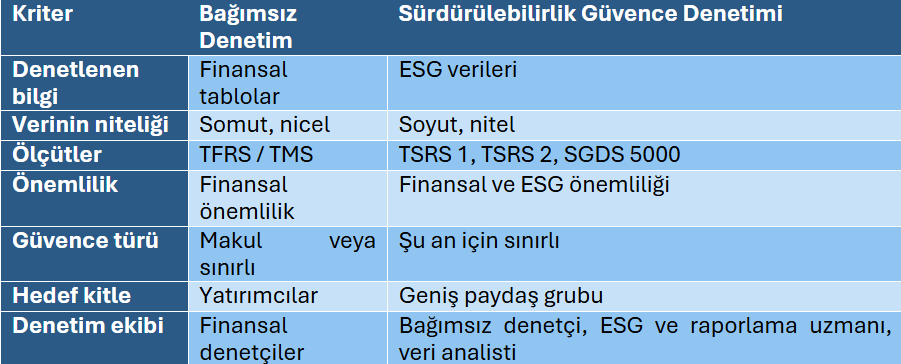
As a result of all these developments, assurance engagements have ceased to be a type in which only financial information is audited and have become an instrument through which environmental and social impacts are audited as well. With the regulation, the understanding of independent audit was broadened and the doors of a new era were opened. The nature of the information audited has changed. Whereas under independent audit only financial statements were examined, in sustainability assurance engagements qualitative indicators, often difficult to measure, have also begun to be assessed. Elements such as carbon emissions, water consumption, natural resource use, human rights and corporate governance practices have begun to be used as audit evidence. In audit processes an interdisciplinary structure has been adopted, going beyond the accounting-based approach. It has become necessary to include engineers, ESG and reporting specialists and data analysts in the process.
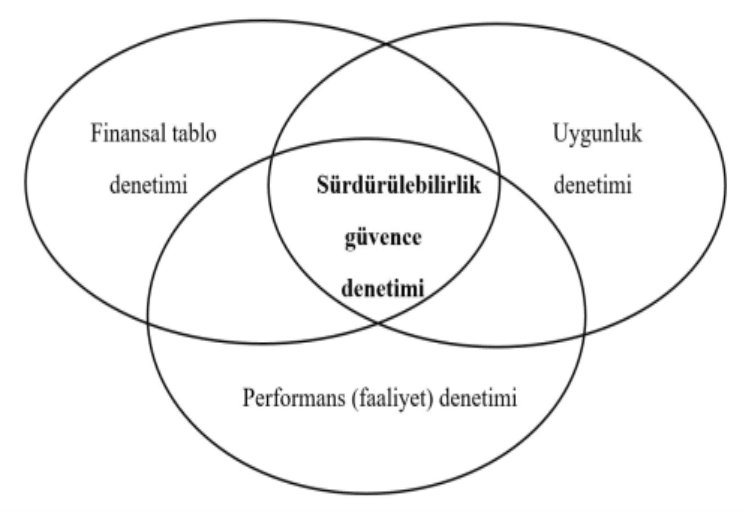
The concept of assurance has also been redefined in this context. While classical independent audits provide reasonable or limited assurance, in sustainability assurance engagements limited assurance can currently be provided. In addition, the concept of “materiality” has begun to be addressed not only through social and environmental impacts but through financial impacts as well. In this respect, sustainability assurance engagements have brought about fundamental changes in the independent audit system.
There has been a transformation in the target audience too. While financial audit reports largely address investors, sustainability assurance reports have begun to be used by employees, customers, regulatory authorities, civil society organisations and society at large. In this way the function of audit reports is not limited to providing confidence in financial markets; it has begun to contribute to the process of building social trust as well.
However, various problems and contradictions currently exist in practice. Various pieces of research, articles and expert opinions state that auditors’ level of expertise on sustainability remains insufficient, that data infrastructures are incomplete, that measurement and verification difficulties are experienced in technical areas such as emission calculations, and that the number of sustainability auditors is limited. Academic articles and opinions also express the view that sustainability auditing examinations and training are weighted towards theory and do not offer sufficient practice-oriented content. Where these conditions exist, there is a risk that sustainability assurance engagements may remain at the level of “assurance in appearance” and may increase the risk of greenwashing.
Within this framework, steps need to be taken by everyone from us reporting consultants to the companies that report and the specialists who audit. First of all, in order to increase the reliability of data collection and reporting processes, companies’ information systems need to be strengthened and a data infrastructure suitable for audit needs to be established. Reporting consultants need to develop and examine sector-based guides and good practice examples. In this way it may be possible to increase consistency and comparability in sustainability assurance engagements. Finally, increasing interdisciplinary cooperation within the profession among the specialists working on the audit side, and carrying out joint work with specialists in fields such as engineering and environmental sciences, also stands out as an important point that could secure the reliability of the process. Strict observance of ethical principles throughout all processes, and scrupulous application of the distinction between audit and consultancy, will strengthen the social-trust-building function of assurance engagements.