

A Science-Based Approach to Product Environmental Claims: The Role of LCA and EPD in Preventing Greenwashing
Sustainability has become a strategic field that both provides competitive advantage in global markets and governs companies’ relationships with their stakeholders. The global transformation in sustainability is no longer limited to companies’ carbon reduction targets; how the environmental performance of products is declared, and how reliable those declarations are, has also moved to the centre of regulatory systems. Although expressions such as “environmentally friendly”, “carbon neutral”, “eco”, “green production” and “in harmony with nature” are used ever more frequently about products, it is emerging that a significant proportion of these claims lack any scientific basis. This is causing the spread of misleading environmental declarations, known as greenwashing. It is precisely at this point that LCA (Life Cycle Assessment) and EPD (Environmental Product Declaration) stand out as the most powerful tools for grounding product environmental claims in a scientific framework. But there is a regulation that will shape this field still further in the near future: the EU Green Claims Directive.
This piece explains the scientific nature of LCA and EPD in preventing greenwashing, and also addresses how the Green Claims Directive creates a new framework of obligations for product environmental claims.
Greenwashing: why is it now a critical problem?
Greenwashing consists of misleading practices that present the environmental performance of a product, service or company as better than it really is. It happens in particular through:
- Environmental claims with no scientific basis (“environmentally friendly”, “eco product”)
- Unproven carbon neutral claims
- Exaggeration of recycling capacity
- Highlighting one advantage of a product while concealing its other environmental impacts
- The use of certificate-like, unscientific, unverified “green logos / invented certificates”
Claims of this kind do not only mislead the consumer; they also devalue genuine sustainability investment. Because of growing consumer awareness and the tightening of the EU’s sustainability regulations, greenwashing is no longer only an ethical problem; it is becoming a legal risk as well. The European Union is regulating product environmental claims by law for the first time, in order to solve this problem systematically.
LCA: the first step in the scientific basis of environmental claims
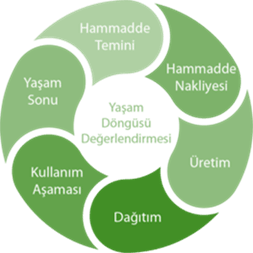
LCA (Life Cycle Assessment) is a scientific method based on the ISO 14040/44 standards that assesses the environmental impacts of a product holistically, from raw material to disposal.
Why does LCA prevent greenwashing?
1) It examines the product’s whole life cycle, not a single stage. Production, transport, use and disposal are all included. In other words, statements such as “the production stage is green but the transport stage is high-carbon” come to light.
2) Assessment across multiple impact categories. Carbon is not the only indicator; dozens of indicators such as water consumption, acidification, eutrophication, fossil resource depletion, waste flows, energy flows and land use are assessed transparently. A product may be good on a single impact and bad on the others — LCA shows this clearly.
3) Transparent data and methodology are compulsory. Assumptions, system boundaries and data sources are reported openly. This transparency prevents claims from being arbitrary. “Withholding information”, the fundamental mechanism of greenwashing, is prevented. Environmental claims made without LCA are largely seen as “marketing language” and carry risk.
4) It provides comparability. LCA studies carried out according to the same rules offer objective comparison between companies.
EPD: turning scientific results into a verified environmental declaration
EPD (Environmental Product Declaration) is the conversion of LCA results into an internationally accepted environmental declaration through independent third-party verification. EPDs published within the scope of EN 15804+A2 in particular are among the most reliable methods of environmental declaration in the European market.
The reasons EPD is powerful in preventing greenwashing:
1) It is verified, transparent and standards-compliant. EPDs are prepared according to the ISO 14040/44 and EN 15804+A2 standards and approved by an independent verifier. Companies publish not their own claim but a verified finding.
2) PCR (Product Category Rules) is a methodological firewall. This prevents declarations from being arbitrary.
3) All indicators must be declared. Not just a “low carbon” claim: all impact categories are disclosed. There is no possibility of magnifying one advantage and ignoring another.
4) Market acceptance is high. It is accepted by green building certifications, public procurement and EU regulations. EPD is the institutionalised form of the scientific declaration.
The EU Green Claims Directive: new obligations for environmental claims
With the Green Claims Directive (GCD), whose draft it published in 2024, the European Union is introducing an obligation for companies to base the environmental claims they make about their products on scientific evidence.
The aims of this directive are:
- To protect the consumer from misleading environmental claims
- To eliminate greenwashing
- To encourage genuine environmental performance
- To provide transparency in the supply chain
- To make competition fair.
According to this directive:
1) Every environmental claim must be based on scientific evidence. Life cycle based analyses similar to LCA are expected to form the basis of that evidence.
2) All claims will be subject to independent third-party verification.
3) Vague expressions will not be usable: “Environmentally friendly”; “Eco product, eco-labelled”; “Zero impact”; “Completely green”; “Carbon-free, carbon neutral” — expressions of this kind will be treated as invalid unless supported by scientific evidence.
4) Carbon neutrality claims will be subject to much stricter rules. In particular, calling something “carbon neutral” using only carbon credits will be prohibited. “Carbon neutral” cannot be supported by carbon credits alone. Genuine emission reduction must be demonstrated.
5) A common method is compulsory for comparative environmental claims. That method will be compatible with PEF (Product Environmental Footprint).
6) Environmental claims that cannot be proven will be subject to sanctions.
Once this regulation enters into force, sustainability claims for all companies supplying products to the EU market will only be able to be made on the basis of LCA, EPD or similarly robust methodologies. An LCA-based methodology is in fact required. At this point the role of LCA and EPD becomes decisive. The directive affects all producers supplying products to the EU market. It is also of high importance for exporting companies in Türkiye.
The direct link between the Green Claims Directive and LCA/EPD
The Green Claims Directive says this plainly:
“Every environmental claim must be supported by scientific evidence and must be life cycle based.”
This provision makes LCA the compulsory methodology and EPD the valid verification mechanism.
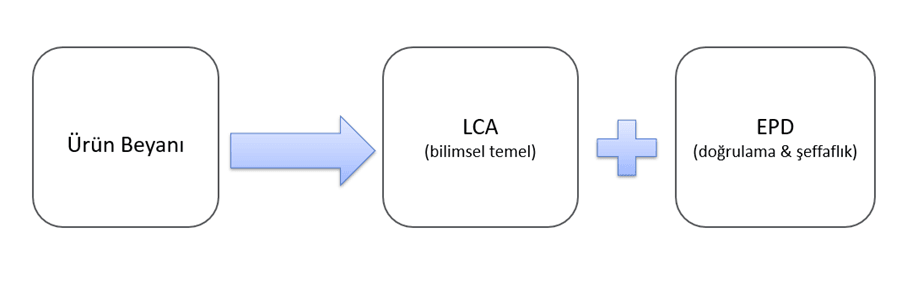
LCA and EPD both protect companies from the risk of greenwashing and provide compliance with new EU legislation.
For greenwashing to be prevented, science, verification and regulation now work together
Environmental claims are now accepted as reliable only when these three elements come together:
- Science-based analysis (LCA)
- Verified declaration (EPD)
- Regulatory obligation (the Green Claims Directive)
This framework gives companies not only risk management but also competitive advantage, transparency and credibility.
With the entry into force of the EU Green Claims Directive, environmental claims at product level will no longer be usable in an unmeasured, undocumented and unverified form. LCA and EPD will come to the fore as the most powerful tools of this new period.
At Metsims we provide expert consultancy support on your LCA and EPD projects so that you do not encounter greenwashing risk in your companies and your products.