
An Underrated Resource: Effective Water Management Through the Corporate Water Footprint
Water. Throughout human history it has always been our most singular resource, associated with concepts such as life, healing and peace. When I say that water is singular, I am genuinely trying to draw attention to its uniqueness and its importance. It is one of the most fundamental building blocks of an organism, and the first remedy we turn to for any ailment. When we think about the supply chain, it is both a stock that is used and a flow that has to be managed. Water is our one resource that can be found in different states at temperatures we can easily reach and in a variety of locations, whose salinity and chemical composition vary, and which can enter and leave the system perhaps by seeping through soil, perhaps by flowing along a stream. Singular, because no other resource can take its place [1].
Even so, most of the time we only understand how much we value water when we are deprived of it. Even a short interruption to supply can turn daily life upside down. What is more, the water we use is not limited to what runs from our taps; almost every form of production and consumption, from the food we eat to industrial processes, depends on water.
It is precisely for this reason that water management needs to be placed on a conceptual footing. The concept of the water footprint was first put forward in 2002 by Prof. Dr. Arjen Hoekstra, who worked at the UNESCO-IHE Institute for Water Education; its methodological framework was elaborated in the Water Footprint Assessment Manual published in 2011, and it was standardised at international level in 2014 with the ISO 14046 standard. By definition, the water footprint is an indicator of freshwater use, and it looks at both direct and indirect water use [2].
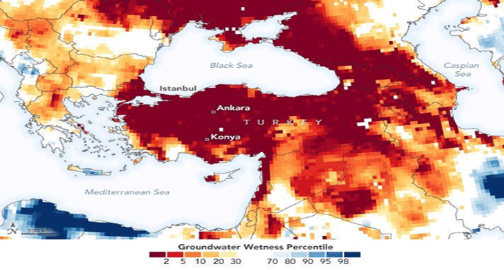
The water footprint is a multidimensional framework that addresses not only water consumption but also water supply and pollution together. The amount of water spent on agriculture in a village in the Aegean, for example, does not on its own constitute a water footprint. The water reserve of the geography in which you spend that water also matters. Alongside this, it is necessary to assess what pesticides are carried by agricultural water, in what quantity, and where they are discharged. In other words, the water footprint by its very nature cannot be assessed through a single unit as the carbon footprint is (CO₂ equivalent); it requires several impacts to be interpreted together.
The consistency of that interpretation is secured by the life cycle approach of ISO 14046. The standard covers direct and indirect water use at every stage, from raw material extraction to processing, production, packaging and logistics, and on to use and disposal. Indirect uses are referred to in the literature as virtual water, and in most sectors they make up a critical part of the total impact. Wearing a pair of jeans, for example, is not an activity that consumes water directly; yet approximately 10,000 litres of water are spent producing that pair of jeans. This water is used throughout the supply chain, from growing the cotton to the dyeing and processing stages, and is included in the product’s water footprint [3].
Calculating the corporate water footprint is not a priority for most companies, because water is a resource priced below its value, and its price often remains below the prices of raw materials and energy. The saying “cheaper than water”, which has settled into our language, seems to be an indication of this. I think the fundamental reason for this is that 70% of the Earth is covered by water — one of the first things I ever learned. The idea that supply is very abundant has created an economic system that prioritises demand. Yet the greatest risk is the nature of water scarcity. Water prices can show sudden and dramatic changes in the event of a constraint on supply. Unlike global warming, this can produce rapid and vital effects rather than ones spread out over time.
At present the great majority of companies carry on their operations in a way that merely complies with minimum legal discharge standards. But in order to continue operating, companies are responsible not only for meeting legal requirements but also for ensuring that their supply chains function without disruption. It is precisely for this reason that effective water management holds great value, especially for businesses with a high dependency on water. Effective water management begins with an analysis of the relationship with water — in other words, with measuring the water footprint.
Through this analysis, companies make visible their dependency on water, their fragile points and potential non-cost risks. What is more, such work has become critical in that it has a scoring effect in sustainability rating systems such as SBTi and EcoVadis and eases access to green finance. Perhaps most importantly, a company is long-lived to the extent that it can reduce the dependency of its operations on limited resources. In short, water management is not only an environmental responsibility but a strategic investment that provides competitive advantage.
Regulation, too, has begun to take shape in response to increasing water risks. The Water Efficiency Regulation, which entered into force in our country in 2024, made it compulsory for industrial facilities, large enterprises and buildings to establish a water management unit; to prepare a water use plan; and to introduce metered monitoring and the use of alternative water sources (rainwater, grey water). It also aims at continuous improvement through annual water efficiency reports and performance indicators [4]. This approach is compatible with both the EU Water Framework Directive and the ISO 14046 methodology. As quantity- and quality-based impacts become transparent, corporate strategies can be managed with concrete metrics.
For companies that have already been carrying out corporate water footprint assessments for some time, the next step may be to extend the system boundaries to the basin. Water is a shared resource, and collective water basin management is therefore essential. Having explained all this at such length, I would not want water management to sound like a very difficult, complicated or unattainable idea. Every land-dwelling creature on Earth already lives within a basin; if every actor achieves this shared management within its own basin, effective water management at the holistic scale will be secured as a natural consequence.
Wishing you a life as cherished as water.
References
[1] C. E. M. S. M. Piero Morseletto, “Circular Economy of Water: Definition, Strategies and Challenges,” Circular Economy and Sustainability, pp. 1463-1477, 2022.
[2] A. K. C. M. M. A. Arjen Y. Hoekstra, The Water Footprint Assessment Manual: Setting the Global Standard, Daugherty Water for Food Global Institute: Faculty Publications, 2011.
[3] International Organization for Standardization (ISO), “ISO 14046:2014 - Environmental management - Water footprint - Principles, requirements and guidelines,” ISO, Geneva, Switzerland, 2014.
[4] Türkiye Cumhuriyeti Tarım ve Orman Bakanlığı, “Su Verimliliği Yönetmeliği,” Resmi Gazete, 32765, 2024.