

Software and Databases in Life Cycle Assessment: A SimaPro and One Click LCA Perspective
Life Cycle Assessment (LCA) aims to analyse transparently the environmental impacts of all the stages of a product or service “from cradle to grave”, in accordance with the ISO 14040/44 standards. As well as setting out the environmental impacts of a product, LCA studies serve as a guiding tool for sustainable production and consumption, enabling businesses to develop environmentally friendly strategies.
Setting out environmental impacts accurately is extremely important for setting the right targets and taking action at the right points. The most critical points in LCA studies are activity data of high accuracy collected with the right methodology, the databases used, and the accurate matching and modelling of the relevant activity data with environmental impact factors. The reliability of an LCA depends on the activity data, the databases and the software infrastructure used.
In an LCA project, data collected in the field is termed primary data, while data obtained from databases is termed secondary data. The use of primary data — the real values obtained in the field — should always be the first choice if the right methodologies were used in obtaining it, but because collecting primary data involves a loss of time and cost, secondary data obtained from databases is used extensively in LCA studies. For this reason the greater part of the total data used in a routine LCA study consists of secondary data. It is almost impossible to carry out an LCA study without secondary data. At the same time, secondary data, which reduces the cost and time of projects, also directly affects the quality of the calculation made.
In the early periods of LCA, studies were carried out mostly on independent data, and the lack of reliable and standard databases was a serious constraint. Until the 1990s, while a number of environmental impact studies were being carried out within the scope of “energy analysis”, databases had not yet been created. The Ecoinvent database that emerged at the end of the 1990s was a turning point in this field and opened the way for transparent, comparable and current data to be used in the scientific and industrial applications of LCA. In the 2000s, database work gathered pace for many sectors. Today a large number of databases specific to different sectors and regions have been developed, and this data is presented to researchers and practitioners in integrated form through software.
Where primary data is absent, the use of standardised, transparent and reliable databases is critically important for the reliability of the data factors and for different LCA studies to be comparable.
LCA software provides the tools that allow databases to be used and modelling work to be carried out with that data. Through the various methodologies they contain, they enable a range of environmental impacts to be reported automatically.
SimaPro
One of the most prominent LCA software packages is SimaPro. Used for many years in both academia and industry, SimaPro allows comprehensive models to be built visually and easily through its user-friendly interface. Thanks to its broad database support (Ecoinvent, Agri-footprint and so on), it produces reliable results for different sectors. The main reason it is preferred in academia is that it offers transparent data management and methodologies accepted in publications; in industry it is used as a powerful decision support tool for sustainable product design and environmental reporting. Working in compliance with standards such as ISO 14040/44 and EN 15804 has made SimaPro a preferred tool not only for research but also for work such as environmental product declarations (EPD). Continuing to develop for more than 30 years, SimaPro maintains its reliability in LCA studies through both its large user community and its regular updates.
Metsims is SimaPro’s sole authorised partner and solution partner in Türkiye.
Databases BUILT IN to SimaPro
Agri-footprint. The Agri-footprint database offers a comprehensive life cycle inventory (LCI) prepared specifically for the agriculture and food sector. Developed by Mérieux NutriSciences | Blonk, this database contains information on approximately 4,800 products and processes covering feed, food and biomass production processes. By supporting a large number of impact categories such as global warming (including land use change), acidification, eutrophication, toxicity, water consumption and land use, it sets out the environmental impacts of agricultural production in detail. In SimaPro’s default version, Agri-footprint data is presented with the economic allocation method; users can, however, integrate mass and energy allocation options free of charge. By offering users mass, energy and economic allocation options, it allows sensitivity analyses to be carried out under different assumptions. Taking the Ecoinvent database as its reference for background processes such as energy and fuel, Agri-footprint stands out as a reliable source particularly for carbon footprint studies of agricultural products, the assessment of bio-based products, and Scope 3 emission analyses within the scope of the GHG Protocol.
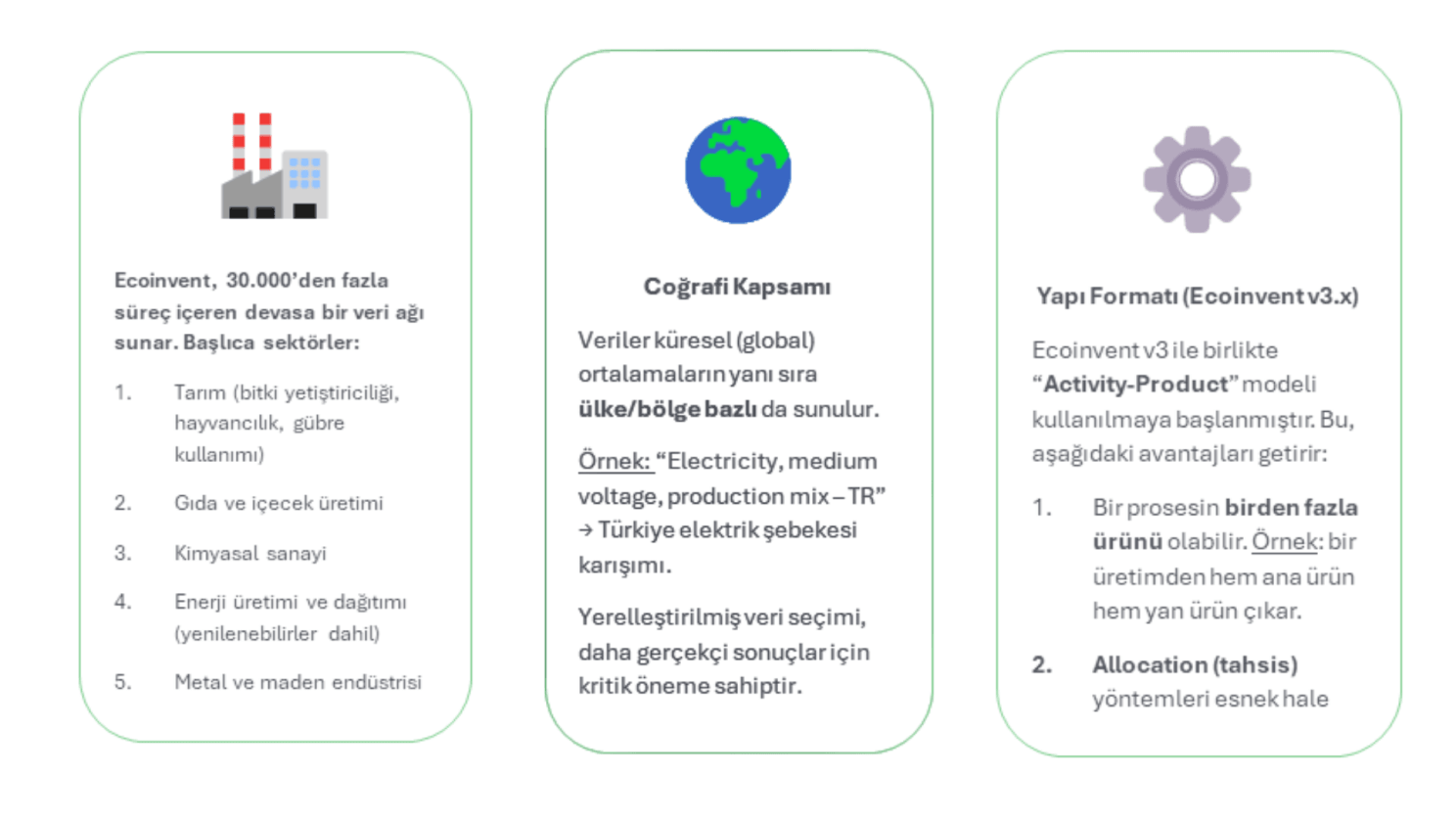
Ecoinvent. Ecoinvent is a life cycle inventory database developed by the Swiss-based ecoinvent Association, which systematically presents the environmental inputs and outputs (materials, energy use, emissions and so on) of processes belonging to different sectors. It was first published in 2003. Its current versions (Version 3.11) are continuously developed and its sectoral data coverage extended. The data is compiled in accordance with standards such as ISO 14040/14044, EN 15804, ISO 21930 and the Product Environmental Footprint (PEF). Ecoinvent is one of the most widely used and most comprehensive Life Cycle Inventory (LCI) databases in the world. It was developed with the aim of providing scientific, transparent and comparable data, particularly in LCA and EPD studies.
EU & Danish Input-Output. The EU & Danish Input-Output database is one of the regional databases in SimaPro. Developed on the basis of input-output tables specific to the European and Danish economies, this database makes it possible to model the environmental impacts of large-scale economic activities. It is used particularly to analyse the environmental footprint of production and consumption systems at country and regional level, and is among SimaPro’s default databases.
Industry Data 2.0. Industry Data 2.0 is a special industry data library integrated with SimaPro and accessible to all users, containing more than approximately 300 data sets provided by sector associations. This database covers sectors such as plastics, detergents and cleaning products, steel and surfactants; the data is compiled from organisations such as PlasticsEurope, worldsteel, ERASM, IMOA and ACE (Alliance for Beverage Cartons and the Environment). The data is at system level — that is, it focuses on the life cycle inventory (LCI) rather than on unit processes — and documentation is provided for each set together with its sources and methodological details. This structure allows industry to integrate its own data directly into LCA models and increases reliability in sectoral analyses.
USEEIO (US Environmentally-Extended Input-Output). USEEIO harmonises the input-output tables of the US Bureau of Economic Analysis (BEA) with environmental data on resource use and pollutant releases such as air, water, energy and minerals. Included in the SimaPro Craft version, this database offers a life cycle inventory (LCI) model at unit process level for 411 different commodity categories — its basic economic data is based on 2012 and its environmental data on the years 2010-2016. In terms of geographical coverage, the model treats the USA as a single region; US regions, sovereign territories and tribal areas are not included in this model. USEEIO offers a wide range of applications, from carbon footprint calculations to environmental analyses, and provides SimaPro users with a powerful resource for US-focused analyses.
USLCI+. The USLCI+ database is an LCI library offered to SimaPro Craft users that comprehensively models energy and raw material flows specific to the United States. This database contains data suitable for individual “gate-to-gate”, “cradle-to-gate” and “cradle-to-grave” process analyses, and also covers life cycle data for the US electricity grid. The USLCI+ model contains more than 550 processes (fuel production, material operations, construction materials and chemicals, for example), and the full cycle of energy flows (“baseline” electricity data) is included in these sets. The data sets within USLCI+ are presented together with metadata and methodological documentation in accordance with Federal LCA Commons principles, providing transparency and traceability. This database offers a powerful infrastructure particularly for US-focused LCA analyses, the environmental impacts of electricity sources and the detailed assessment of material production processes.
Databases that can be integrated into SimaPro FREE OF CHARGE
Agribalyse. An LCI (Life Cycle Inventory) database focusing on agriculture and food substitution specific to France. Developed by a scientific consortium led by ADEME, this data set contains unit process level data for 2,517 agricultural and food products produced or consumed in France. For imported products it draws on the Ecoinvent and WFLDB databases. In terms of modelling and methodology, Agribalyse largely complies with international guidance such as ISO, LEAP and PEF. For SimaPro users to be able to use Agribalyse, they must have SimaPro version 10.2.0.3 or newer and a valid Ecoinvent licence.
Environmental Footprint. The Environmental Footprint database is an LCA data source developed within the scope of the European Commission’s Single Market for Green Products initiative. This database contains life cycle inventory (LCI) data sets in accordance with PEFCR (Product Environmental Footprint Category Rules) and OEFSR (Organization Environmental Footprint Sector Rules) rules, together with compatible impact assessment methods. Users can calculate the environmental performance of their products with this data, benchmark them against average products in Europe, and identify areas for performance improvement.
EXIOBASE. EXIOBASE v3.3 is a multi-regional, environmentally extended input-output (Supply & Use / Input-Output) database usable in SimaPro. This database covers 43 countries (economies corresponding to around 95% of global GDP), and offers detail at the level of more than 160 industrial sectors and 200 product categories. EXIOBASE provides a comprehensive analytical infrastructure by modelling not only monetary relationships but also physical flows (such as energy, water, emissions and resource use). It also contains 21 different indicators relating to industry-based social and economic flows.
WEEE LCI. The WEEE LCI database is a French-connected life cycle inventory (LCI) library designed to model end-of-life processes for electrical and electronic equipment (EEE). This database contains more than 900 process data covering the disposal and recycling processes of household and some sectoral EEE, 86 different material types, and recovery data for the three main plastic types obtained from WEEE (PP, PS, ABS).
Databases that can be integrated into SimaPro FOR A FEE
Carbon Minds. Carbon Minds’ cm.chemicals database is a large-scale LCI (Life Cycle Inventory) database developed for users wishing to carry out environmental assessment in respect of chemicals and plastics. It is presented in SimaPro format and supported with annual updates using a consistent methodology in accordance with the ISO 14040 / 14044 / 14067 standards. This database covers the main components representing approximately 75% of greenhouse gas emissions arising from chemical and plastic production worldwide. The data allows modelling at the level of 190 regions, so that users can carry out geographically detailed analyses.
Different package options are available for cm.chemicals: the “Essentials – Global Insights” package contains representative production and consumption mixes for chemicals, while the “Plastics – Global Insights” package covers technological mixes and production processes specifically for plastic products.
DATASMART LCI package. Developed by Long Trail Sustainability (LTS), DATASMART contains more than approximately 700 original data sets covering processes such as US-specific electricity mixes, natural gas processes, biofuel models and waste management. (longtrailsustainability.com manual) DATASMART is based essentially on modified versions of US LCI v1.60 and Ecoinvent v2.2 data; this data is brought into line with local US conditions (US electricity mixes, natural gas extraction, state-level energy distribution, for example) and rests by default on the customisation of Ecoinvent’s Europe-weighted data for the USA.
ESU World Food LCA. The ESU World Food LCA database has approximately 1900 life cycle inventory (LCI) data sets covering the food sector worldwide. This database contains many food-related processes such as agricultural production, vegetables, fruit, animal products, fisheries, dairy products, meat alternatives, staple foods, beverages, desserts, ready meals, in-home consumption and pet foods.
All system processes are presented as SimaPro’s background library and can work in a way compatible with all the impact assessment (LCIA) methodologies SimaPro supports. The data is documented entirely in electronic EcoSpold v1 format and can be purchased both as unit process and as system process. The environmental intensities of products (CO₂ equivalent per kg, for example) are also provided within the scope of the database.
IDEA Japanese Inventory. IDEA v2 (Japanese Inventory Database) is a hybrid (statistical plus process-based) inventory database covering almost all sectors of the Japanese economy. Presented in SimaPro as unit process data sets, IDEA contains approximately 3,800 processes; it covers both manufacturing and service sectors such as agriculture, forestry, fisheries, mining, construction, chemicals, metallurgy, textiles, energy, water and waste management. Each process is labelled with an IDEA code and has a hierarchical structure based on the Japan Standard Commodity Classification. In addition, the newly added land use and water flow data is based on statistics specific to Japan. It includes the main impact categories such as global warming, acidification, ozone layer depletion, fossil resource depletion, water resources and land use. The database is widely used in LCA studies in Japan; a subset of IDEA has been used, for example, in determining some emission factors in national carbon footprint trial projects.
Social hotspots. The Social Hotspots Database (SHDB) is a database intended to analyse social risks in the supply chain. Offered for use in SimaPro, this database uses a global input-output model covering 140 countries and regions and taking in 57 economic sectors. SHDB contains social indicator sets such as workers’ rights, health and safety, human rights, governance and community infrastructure. In modelling the supply chain, sector- and country-based processes are derived on the basis of global trade data (GTAP) relating to a particular product category, and the labour intensities (working hours) of these processes are estimated to identify social risk “hotspots”. In this way it can be determined which processes carry higher social risk, and it becomes possible to develop more ethical and responsible sourcing strategies.
ONE CLICK LCA
One Click LCA is a cloud-based life cycle assessment (LCA) software originally developed particularly for the construction sector. Its main focus is calculating the environmental performance of buildings, infrastructure and materials and reporting those results in a way compatible with green building certifications (LEED, BREEAM, DGNB, HQE and so on). Its user-friendly interface, automatic calculation modules and sector-specific integrations have considerably increased its areas of use.
One Click LCA began to be developed by Bionova Ltd., founded in Finland in 2001, and its first version was released in 2010 for carbon footprint and LCA calculations for the construction sector. In the 2010s it was made cloud-based, integration with EPD databases was provided, and its compatibility with green building certifications was developed. In the 2020s the software, becoming global, continued to develop beyond the construction materials sector.
One Click LCA focuses on the use of primary data rather than secondary data, and on the use of customised study results appropriate to primary data. Rather than a single source, it combines a large number of EPDs, LCA data sets and generic data, and enables that data to be used appropriately according to parameters such as the product’s production technology and geographical coverage. Where data of that kind is not available, it also allows the use of generic data from databases such as Ecoinvent and Agri-footprint.
The merger of SimaPro with One Click LCA
The merger of SimaPro with One Click LCA is regarded as an important turning point in the LCA world. SimaPro has long held a strong position in academia and research thanks to its transparent data management, methodological flexibility and compliance with internationally accepted standards. One Click LCA, by contrast, stands out for its user-friendly solutions developed particularly for the construction sector and green building certifications (LEED, BREEAM and so on). The merger of the two software packages brings together comprehensive databases prepared with academic rigour and practical sector-focused tools, offering users both broader data coverage and sectoral solutions. This makes it possible for LCA to be integrated far more quickly and effectively into decision-making and certification processes in different industries, and particularly in the construction sector. While SimaPro and One Click LCA continue their lives as two separate software platforms, exciting developments in the LCA sector are foreseen in the coming years through joint and stronger modules and software.
Metsims Sustainability Consulting, alongside its SimaPro global partnership, continues to provide services in more than 20 countries with “tailor-made” LCA databases and software created specifically for clients.