
Sustainability Agenda
11–28 August 2026
8 updates
Türkiye Emissions Trading System Regulation Published
The regulation setting out the implementation principles of the Türkiye Emissions Trading System was published. The regulation provides a clearer framework for the classification of ETS-covered installations, monitoring, reporting and verification of emissions, emissions permits, and allocation processes. The development represents an important step in Türkiye’s carbon pricing framework and transition towards a low-carbon economy.
What changes?
The Regulation defines ETS-covered installations, emissions permits, monitoring and verification requirements, and allowance allocation principles.
For More Details: https://www.resmigazete.gov.tr/eskiler/2026/08/20260827-7.htm

Details of the UK CBAM Implementation Continue to Take Shape
The implementation framework for the United Kingdom’s Carbon Border Adjustment Mechanism remained on the agenda. Registration and compliance processes, methodologies for calculating embedded emissions, and verification principles were among the key topics, while the differences between the UK CBAM and the European Union CBAM also emerged as important areas for companies to monitor closely.
What changes?
The UK CBAM will apply from 1 January 2027 to selected carbon-intensive imports. Unlike the EU CBAM, it will operate through a tax-based mechanism.
New Guidance Documents Published for the CBAM Definitive Period
The European Commission published ten new guidance documents for non-EU installation operators under the CBAM definitive regime. The documents cover core CBAM concepts, implementation guidance for non-EU operators, methodologies for calculating embedded emissions, the calculation of the free-allocation adjustment to CBAM certificates, and dedicated guidance for cement, hydrogen, fertilisers, iron and steel, aluminium and electricity.
What changes?
New guidance clarifies embedded emissions calculations and sector-specific requirements for the CBAM definitive period.
A New Era for Circularity and End-of-Life Vehicles in the Automotive Sector
Circularity requirements in vehicle design and the End-of-Life Vehicles Regulation became key topics on the automotive sector’s agenda. The new approach places issues such as vehicle recyclability, reuse of components, and increased use of recycled materials in production at the centre of the automotive value chain.
What changes?
New rules introduce requirements on vehicle recyclability, recycled content, reuse, end-of-life treatment and producer responsibility.
Presidential Circular on the Implementation of Türkiye’s Artificial Intelligence Action Plan Published
A Presidential Circular was published regarding the implementation of Türkiye’s 2026–2030 Artificial Intelligence Action Plan, which sets out the country’s priorities and implementation steps in the field of artificial intelligence. The Action Plan provides a roadmap for developing the AI ecosystem, expanding the use of AI across the public and private sectors, and strengthening digital transformation capacity.
What changes?
Türkiye’s 2026–2030 AI Action Plan sets out 16 priority actions covering skills, infrastructure, applications, financing and governance.

National Financing Opportunities for the Green Transition Updated
The document bringing together national financing and support mechanisms available to companies for green transition investments was updated. It includes financing and support opportunities offered by various ministries and public institutions for energy efficiency, renewable energy, low-carbon production, and the improvement of environmental performance.
What changes?
Türkiye’s national green-transition financing document was updated with current public funding and support mechanisms.

Guidance on CBAM Verification and Accreditation Processes Published
A verification and accreditation guidance document was published for verifiers and national accreditation bodies operating under the CBAM framework. The guidance details the implementation principles related to verification planning, risk analysis, site visits, verifier competency criteria, and accreditation processes.
What changes?
The guidance clarifies verification, site visits, verifier competence and accreditation requirements under CBAM.
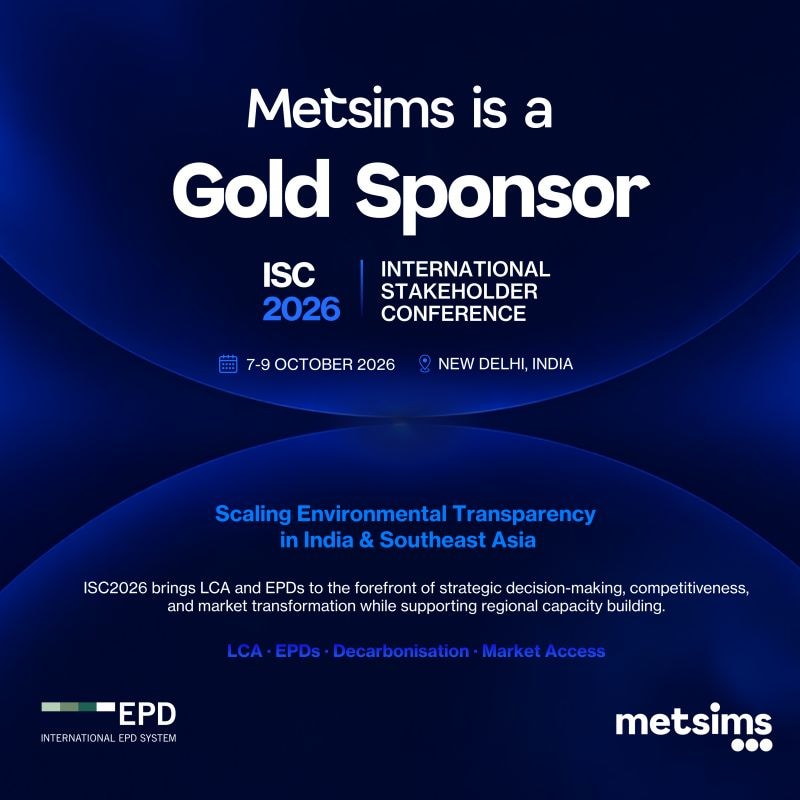
Metsims is a Gold Sponsor ISC 2026
Metsims will take part in the International Stakeholder Conference (ISC) 2026 as a Gold Sponsor.
Taking place in New Delhi, India, on 7–9 October 2026, this year’s conference will focus on “Scaling Environmental Transparency in India & Southeast Asia.”
ISC 2026 will explore the role of Life Cycle Assessment (LCA) and Environmental Product Declarations (EPDs) in strategic decision-making, competitiveness, and market transformation.