

The Carbon Border Adjustment Mechanism: Compliance, the Legal Timetable and Digitalisation
While the world fights against the climate crisis, countries are having to put on the table not only the emissions within their own borders but also the carbon footprint they carry through trade. At this point the European Union has taken a very critical step: the Carbon Border Adjustment Mechanism (CBAM). This mechanism is not only environmental policy; it also presents a structure that will change the rules of trade. So why is such an application needed?
While traditional carbon regulations take the country of production as their basis, CBAM also seeks the answer to the question “Where is the product going and how was it produced?”. The reason for this is that, while trying to reduce carbon emissions, the EU does not want production to shift to countries with more flexible environmental rules. It is precisely at this point that the concept of carbon leakage arises.
CBAM is a system created to prevent carbon leakage and to balance the cost of carbon on a global scale. In other words, the issue is not only the environment; competition, fairness and the balance of trade are also right at the centre of it.
What is CBAM and why is it being applied?
CBAM (Carbon Border Adjustment Mechanism) is a carbon pricing system established by the European Union in line with its climate policies. This mechanism provides for an additional cost to be applied to carbon-intensive products imported from outside the EU, similar to carbon pricing within the EU.
The fundamental aim of CBAM stands out as being both to prevent carbon leakage and to reduce greenhouse gas emissions on a global scale. Carbon leakage means that, when a country places limits on carbon emissions, carbon-intensive production activities shift to countries with looser environmental policies. For example, because carbon costs are high in the EU, a steel producer may move its production to a country such as India where carbon regulation is weaker. In that case emissions do not fall on a global scale but merely change location geographically. CBAM serves precisely the aim of solving this problem and equalising the cost of carbon regardless of where production takes place. In this way the competitiveness of EU industry is protected and, in terms of climate policy, a fair balance at global level is targeted.
When did it enter into force? (with the transitional periods)
CBAM formally entered into application with the transitional period on 1 October 2023.
Transitional period: October 2023 – December 2025
During the transitional period there is as yet no financial obligation; in this process there is only a reporting requirement. Companies exporting to the EU, or importers, are required to declare the embedded emissions arising in the production process for products within scope. The fundamental purpose of this period is to enable companies to learn how the CBAM system works and to allow them to build the necessary data collection and reporting infrastructure.
Full application will begin as of 1 January 2026
As of 1 January 2026 CBAM will come fully into force and, going beyond the reporting-only obligation of the transitional period, will turn into a binding system covering financial obligations as well. From that date, purchasing a CBAM certificate will be compulsory for every tonne of carbon emissions arising during the production of products within scope imported into the EU. The price of the certificates will be determined according to the carbon prices set in the EU Emissions Trading System (ETS). That is, if for example the price set in the ETS for 1 tonne of CO₂ equivalent is €90, importers will pay a similar amount for the same quantity of certificates. However, if a carbon price has already been paid in the country where the product was produced (a carbon tax, for instance), that amount may be deducted from the CBAM payment. In addition, as of 2026 importers will need to have their emission data approved by independent verification bodies and to declare this verified data to the EU regularly. In cases such as non-compliance, incomplete notification or late reporting, serious financial sanctions will apply. In this period CBAM will become not only an environmental but also a commercial obligation, and will directly affect competitive conditions for companies in countries trading with the EU.
Which sectors does it cover?
Sectors covered at the outset:
- Iron and steel
- Aluminium
- Cement
- Fertiliser
- Electricity
- Hydrogen
These products stand out as being both carbon-intensive and subject to intense competition in global trade.
Which emissions does CBAM take into account?
CBAM takes into account the direct and indirect greenhouse gas emissions arising during the production of the product.
Direct emissions: CO₂ arising directly in the production process (for example, the combustion of coke coal in steel production).
Indirect emissions: emissions arising from the electricity used in the production process (in particular as optional reporting for some sectors during the transitional period).
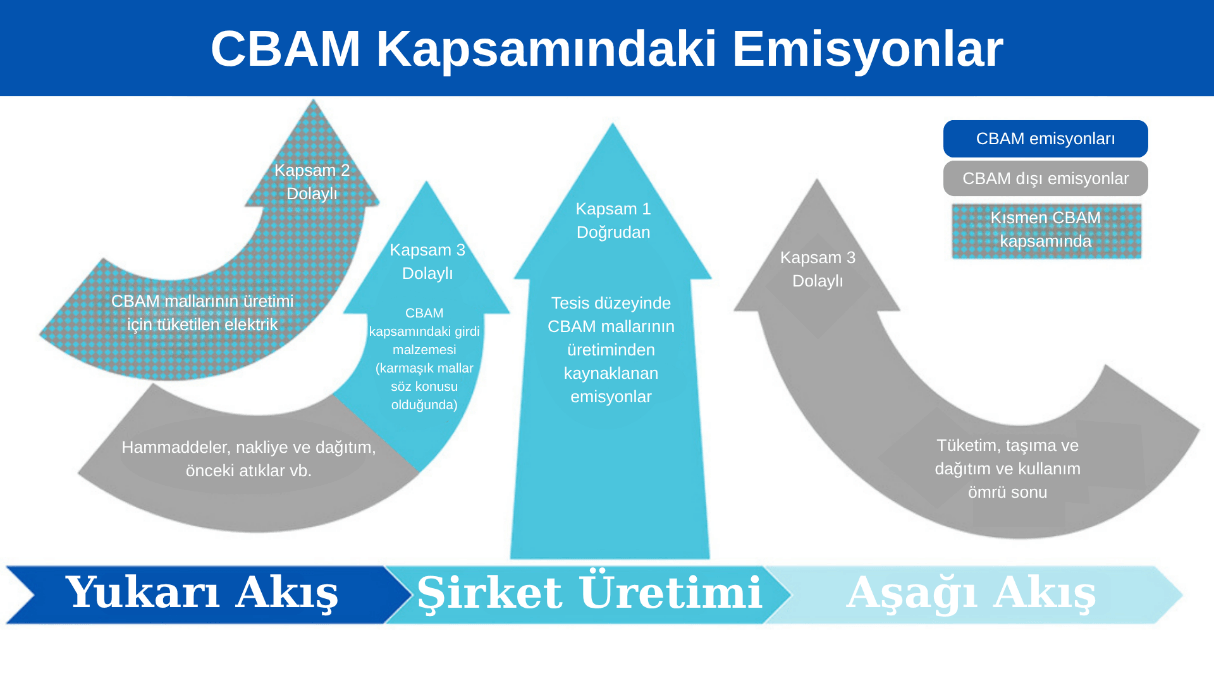
The EU has developed standard methodologies for the emissions to be calculated under CBAM and expects the carbon content of imported products to be declared correctly. Where exporting companies are able to submit verifiable emission data for their production processes, that specific data is taken as the basis. However, if a company cannot submit its own data, the default emission values determined by the EU Commission come into play. Because these values are generally calculated according to the average of the top 10 countries with the highest greenhouse gas emissions among those with high emission intensity, they are in most cases higher than reality. This in turn causes companies to have to purchase more CBAM certificates and therefore to face higher costs. For this reason, submitting their own verified emission data provides a serious advantage, both environmentally and financially, for exporting companies producing accurately and with low emissions.
What should companies do?
CBAM requires a strategic transformation, particularly for companies exporting to the European Union. Within this scope, companies first need to begin calculating their carbon emissions on a product basis. All inputs such as the energy sources used in production facilities, raw material types and production processes must be monitored carefully and emission data collected reliably. Following that, a system must be set up to report this data in the formats determined by the EU. Even during the transitional period, companies with high reporting quality can gain a serious advantage in the EU market. Establishing effective communication with importers in the EU is also of vital importance in this process; because for importers to be able to fulfil their CBAM obligations, they need timely and accurate emission information from producer companies. For this reason companies are expected to develop coordination specific to CBAM within the supply chain. On the other hand, the most lasting way to lighten the CBAM burden is to reduce the carbon footprint. Measures such as the transition to renewable energy, the improvement of production processes and energy efficiency both reduce environmental impact and lower CBAM costs. Finally, it is of great importance that emission data be transparent and auditable. To that end, obtaining documentation from internationally valid carbon calculation and verification systems provides companies with a serious advantage in terms of both regulatory compliance and commercial reputation.
Digitalise your CBAM processes with CageSuite CBAM
The CageSuite CBAM software developed by CageSuite Sustainability Platform, with which Metsims is a solution partner, makes it possible to manage the reporting and supply chain audit processes within the scope of the Carbon Border Adjustment Mechanism (CBAM) quickly, reliably and in a user-friendly way. Thanks to this software, a quarterly CBAM report can be produced in just a few steps, in less than 5 minutes.
Thanks to its integrated data structure, CageSuite CBAM allows you to follow current carbon prices under the European Union Emissions Trading System (EU ETS) in real time. In addition, with its continuously updated supplier database, it analyses the carbon footprint in your production processes and offers optimisation suggestions for lower-emission production.
Developed as part of the Cage ecosystem, CageSuite CBAM goes beyond fulfilling CBAM obligations to offer a comprehensive digital solution supporting data-driven decision-making processes.