

The Digital Product Passport: Complying with EU Regulations
In line with its sustainability and circular economy goals, the European Union is putting the Digital Product Passport (DPP) into practice in order to increase the traceability of products throughout their life cycle. DPPs aim to provide all stakeholders, including consumers, with transparent and comprehensive information about the materials products contain and their environmental impacts.
Emerging as part of the Ecodesign for Sustainable Products Regulation within the scope of the European Union’s Circular Economy Action Plan, DPPs aim to present, in a digital format, the environmental impacts a product has throughout its life cycle (raw material sourcing, production, use, recycling) together with production and supply chain information. Within this scope, companies operating in the sectors listed below and selling into Europe are expected to obtain DPPs progressively from 2026 onwards.
- Iron and steel
- Aluminium
- Textiles
- Furniture
- Detergents
- Paints
- Lubricants
- Chemicals
- Information and Communication Technology products
- Energy-related products subject to ecodesign requirements
Among these sectors, the DPP requirement is being made compulsory first for batteries. From 18 February 2027, light means of transport, batteries with a capacity greater than 2 kWh and electric vehicle batteries placed on the EU market will be required to carry a DPP. Within this scope, the operation of the system will first be tested through the DPP applied to batteries and its shortcomings addressed. The regulatory groundwork for the other sectors is then expected to be completed and the scope of the DPP requirement widened as of 2027.
DPP content
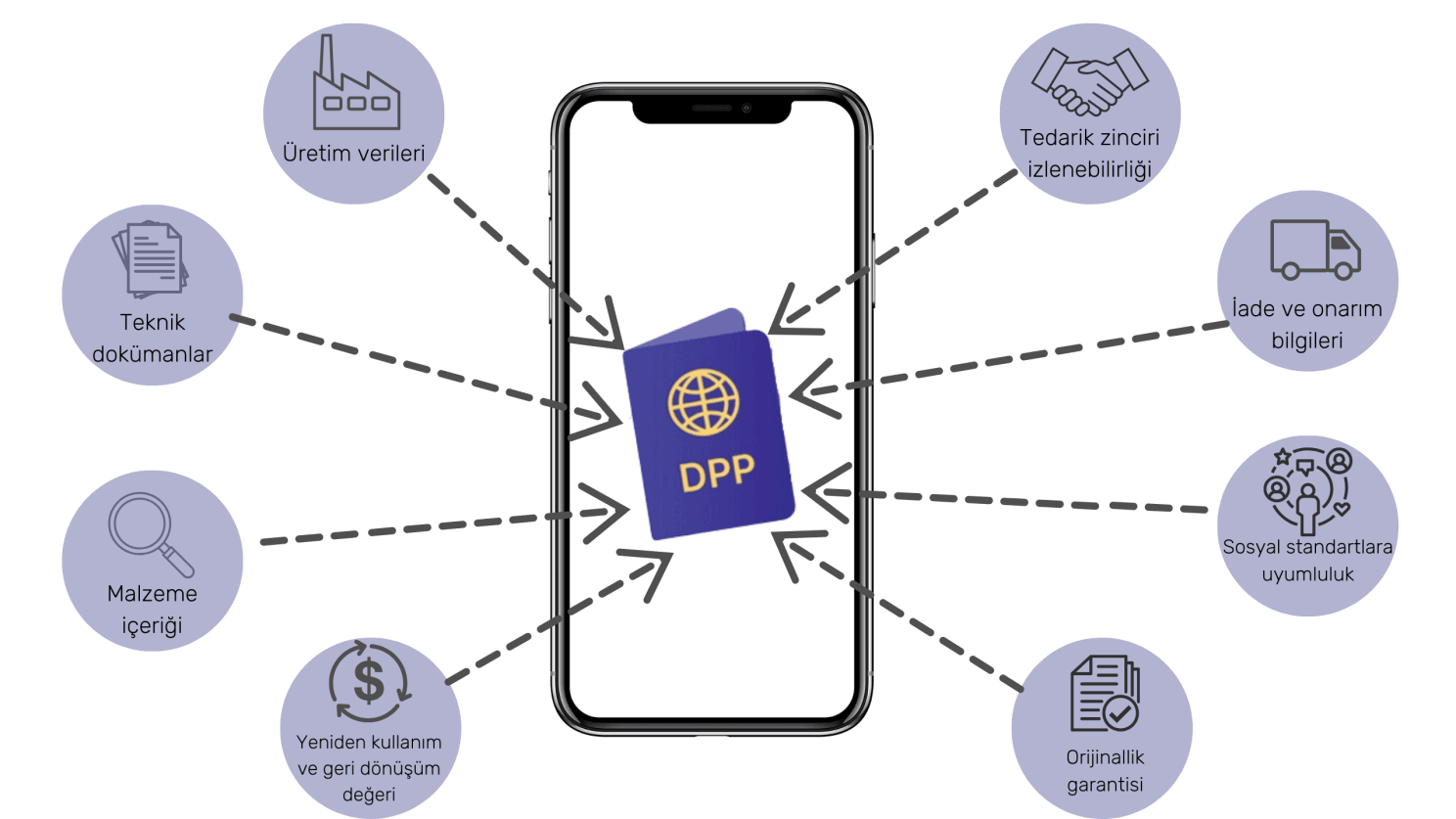
The following information is planned to be included in the DPP:
- Material and component information (raw materials used in the product, recycled material ratios, chemical contents and so on)
- Carbon footprint and other environmental impacts
- Information about the production process (origin, types of energy used, supply chain information and so on)
- Recycling and waste management information
Manufacturers within the scope of the DPP need to integrate the DPP into their products by the dates set by the regulation. Within this scope, manufacturers in Türkiye are also required to comply with the relevant arrangement in order to be able to export to the EU market. This arrangement needs to be seen as a compulsory requirement, just like the existing “CE” marking.
What should companies in Türkiye do?
Companies already selling to the EU continue to receive various requests relating to their products under the heading of sustainability. While there are certification requests such as LCA, EPD and CBAM, it is of great importance to follow the regulations closely and to stay up to date on the DPP.
In most of the sectors within the scope of the DPP, a large part of the environmental impact of products stems from the raw materials used. For this reason, achieving 100% alignment with the supply chain and setting up a system that can easily obtain the requested data from suppliers is regarded as essential. Companies reporting under CBAM have already experienced how critical a role supplier data plays. Maintaining the same understanding within the scope of the DPP is seen as a critical element in complying with EU regulations.
In addition, carrying out carbon footprint and Life Cycle Assessment (LCA) studies is considered necessary in order to evaluate the environmental performance of products within the scope of the DPP. This emerges as one of the areas on which manufacturers in Türkiye need to focus most. At present the number of companies with the competence to carry out LCA for their own products is quite small, while the need for professional support is steadily increasing.
There is also an initiative to take product carbon footprint and LCA data from EPD (Environmental Product Declaration) documents. While hundreds of companies currently hold EPD documents obtained for their products, these documents are published openly for everyone’s access following approval by an independent verifier. Because they are technically aligned with the ISO 14040/44 standards and, for construction products, the EN 15804 standard, EPDs in fact contain many of the needs set out in the DPP. For this reason, the approach under consideration is to take the product environmental impacts to be recorded in the DPP directly from EPD documents, without the need for any other study. If this approach is approved by the EU, it will be possible to have product environmental impacts written into the DPP via the EPD. That in turn means that obtaining EPDs for their products will become even more important and critical for companies.
At Metsims, we have been supporting companies at every point of sustainability for 20 years. You can get in touch with us for detailed information on the subject and for an assessment of the process specific to your company.