

Early Planning for Corporate Carbon Accounting
Corporate carbon accounting, which has become one of the most important inputs to the corporate sustainability work that is now a focus area for companies operating largely in the private sector, has evolved into a process that must be carefully planned from the very beginning as the criteria set by global frameworks become more transparent by the day. Planning carried out in a way that suits the standards and expectations, without granting concessions, results in work that is both effective in returning value inside the organisation and carried out in full compliance, continuously from year to year.
This process, which can be implemented with the Greenhouse Gas Protocol and/or ISO 14064-1 in particular, and also with methodologies such as those of the IEA, may be conducted on a voluntary or a mandatory basis. Carbon accounting studies that were conducted voluntarily in the past have begun to be conducted on a mandatory basis in line with different national and international reporting standards, international sustainability measurement frameworks, and supplier and customer demands.
Before beginning carbon accounting, companies need to establish why they are doing the work in the current situation, where they may be able to use it in the future, and — if it is to be tracked — on what plane that tracking will take place; and then, together with a high-level SWOT (strengths and weaknesses, opportunities and threats) analysis, to integrate their business workflows into the work. Points such as prioritising the preparatory work for collecting data that will reflect the company’s principal activity and the primary sub-activity arising from it (systems, establishing the readiness of the relevant team, and so on) are highly important. Companies that correctly establish their purpose in carrying out the work, and what potential actions they may need to take in the future, can be regarded as having taken the first step towards ensuring continuity in carbon accounting by building the infrastructure from the outset against the requirements they will face.
Noting that sectoral exceptions exist, the early process of carbon accounting can be set out in stages.
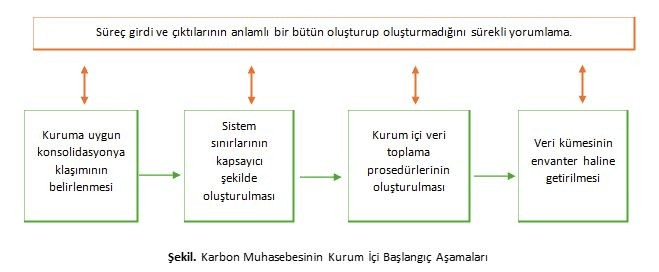
The process begins with a comprehensive corporate carbon accounting work plan being consolidated according to the organisation’s culture, its sectoral realities and its technical infrastructure. It often becomes impossible to return to this stage once the work has started, unless the base year is changed. Therefore, at the start of the work, the organisation’s operational and financial authority network, subsidiaries and venture investments should be mapped completely; scenarios should be built through internal consultation; and consolidation should be completed in a way that matches the organisation’s expectations.
Once the consolidation approach is complete, the organisation is in a position to begin carbon accounting by determining its boundaries. At this point, while they are entirely the same in terms of system boundaries, emission sources, inventory type and calculation methodology, they should also be determined conceptually. The conceptual process may again be shaped by the culture of the organisation, stakeholder expectations and similar reasons. The Greenhouse Gas Protocol and ISO 14064-1 standards that regulate this process serve as guides for organisations. One or both of the standards should be selected and the system boundaries recommended by the standard determined. In determining the system boundaries, direct and indirect emission sources are identified for the consolidated organisational governance. Here the most comprehensive boundaries possible should be determined, bearing sectoral realities in mind. Otherwise, compliance with international frameworks that lower the threshold values of their criteria in future may become difficult, and matters such as recalculation for past years, and even changing the base year, may come onto the agenda.
After organisations have determined their system boundaries, the relevant data sources within the organisation should be identified. Which data from the emission sources within the boundaries is needed, and at what quality, should be prioritised; the effort the organisation will expend should be distributed in an optimised way, more effort than necessary should be prevented, and time management should be made effective. Matters such as how and through which units data is held in the organisation, and how data-driven governance will be designed in subsequent years, should be discussed. The quality of the data should be subjected to analytical control and interpreted with sectoral realities in mind. As well as producing effective carbon accounting work, this stage can also provide organisations with cross-benefits such as a review of business workflow processes and a holistic analysis of the current situation.
Once the data sets have been formed and the quality processes completed, these data also need to be consolidated. Data coming from every level of the organisational chart should be consolidated within the relevant system boundaries, and these data sets should additionally be put through a second check inside the organisation and, if needed, outside it. Data sets judged ready for processing should finally be turned into an inventory and held as an internal output for use in carbon accounting.
All these processes, staged in Figure 1 and defined above, are the stages at which effective and continuous corporate carbon accounting directly concerns organisations and must work holistically. Today organisations have begun to undertake work aimed at increasing internal communication in order to complete these processes successfully. It is important for every network of the organisation to be in communication and consultation with the others, so that every actor meets in common benefit. As long as an organisation can reach a common decision with all its stakeholders, it speaks the same language and can successfully track its future targets, plans and reporting.
Our organisations face criteria whose minimum requirement thresholds are becoming considerably more demanding, in order to respond to steadily increasing international demands. Meeting these demands depends on being able to carry out effective and consistent carbon accounting. Carbon accounting has become work in which the calculation methodology and reporting alone are not enough, and in which early process planning must also be correctly designed. As Metsims Sustainability Consulting, with experience across many national and international sectors and in different organisational structures, we continue to draw on our effective field and project experience to design corporate carbon accounting processes in which we stand alongside our organisations end to end, through all their processes.