

Where Is Climate Impact Governance Heading? TSRS, Holding Structures and Alignment with Financial Reports
Introduction and current situation
There are many methods, regulated by different standards and requirements, for measuring organisations’ impact on climate change. Corporate carbon and water footprint metrics are currently the most frequently requested. While I expect new corporate metrics such as corporate biodiversity and corporate social impact to arrive in the near future, I should like to shape this piece around the corporate carbon footprint.
In this piece I shall not go deeply into the conceptual basis, but I should like to recall the cornerstones. We track the corporate carbon footprint through direct and indirect emissions, within defined organisational boundaries, with the system boundaries in which the relevant activities sit. In a sense we are taking a photograph of the organisation from end to end.
After the Türkiye Sustainability Reporting Standards (TSRS) entered into force, direct emissions and energy indirect emissions were made compulsory for companies within scope for the first 2 years. The exemption for value chain indirect emissions will end for companies completing the transition period. A TSRS-compliant report must be published together with the annual financial report. Accordingly, the previous year’s corporate carbon footprint study needs to have been completed in roughly the first quarter.
A carbon footprint study can take a considerable amount of time, particularly for value chain indirect emissions and where the company’s operational structure is complex. Once data that must be obtained from different business units, the checking and suitability of that data, and its processing enter the picture, the effort shown in the reporting process will increase significantly compared with previous years.
As far as we see in the market, companies making voluntary declarations on the Scope 3 side treat their voluntary status as a process of adaptation. Although this action may at first be seen as extra effort, it is clear that it will provide an advantage in terms of process optimisation in subsequent years. A carbon footprint process whose foundations are well laid during the exemption period will certainly provide readiness in the compulsory reporting years.
Although the declaration of the carbon footprint study requires data verification in the audit of the sustainability report, it does not for the moment make a separate verification of the carbon footprint study compulsory. While limited assurance is recommended for Scope 1-2 activities, on the Scope 3 side there is — for now — no obligation.
2. Holding (Enterprise) structures
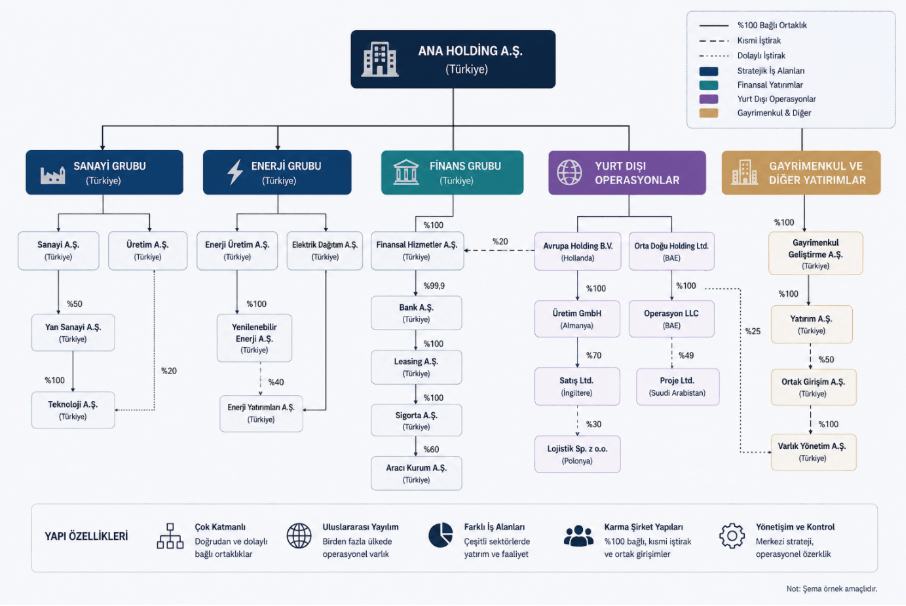
In companies with different organisations and a large operational network, the governance of the carbon footprint metric becomes considerably more complex with TSRS. The fundamental difference here from previous work arises from the fact that the TSRS-compliant sustainability report is in essence a decision mechanism supporting the financial report. This brings with it the obligation to consolidate carbon footprint results in a way that is aligned with the financial report. Many requirements calling for particular work are encountered: intra-group purchases and sales, duplicated shareholdings, shared buildings and employees, shareholding percentages that change every year.
In a TSRS-compliant report, correct consolidation and alignment with the financial report (see heading 3) are critically important for the report’s continuity and for a consistent presentation to investors. Although in the first years of application changes in results from one year’s report to the next may be partly accepted provided a suitable explanation is given, securing consistency in later years becomes a factor affecting organisations’ reputation with investors.
While compliance is achieved during consolidation with the standards that regulate carbon footprint studies, selecting the approaches most suited to the organisation’s operations will at the same time ensure that financial data and carbon footprint metrics are aligned. Accordingly, IFRS-compliant accounting consolidation, TSRS consolidation and carbon footprint metrics will be interpreted together and will produce correct outputs. (For detailed information on consolidation approaches, see Early Planning for Corporate Carbon Accounting.)
These developments require organisations to adapt their governance models for corporate carbon footprint work to the new order. Compliance with annual reporting periods, improvement in the quality of calculation, and the ability to respond quickly to changing conditions are the most critical points of this governance model. Running the process with the participation of more than one unit is possible by building the technical infrastructure on solid foundations. At this point organisations are required to replace manual methods, as far as possible, with more reliable and faster digital solutions. We see that digital transformation is now unavoidable in corporate carbon footprint work as well.
3. Alignment with financial reports
With TSRS, corporate sustainability reporting becoming an inseparable part of financial reporting makes it necessary for carbon footprint work to cease being merely an environmental performance indicator and to become an input to the financial reporting architecture. This requires emission data produced at consolidation level in particular to be presented in a structure that is fully aligned with the financial statements, traceable and auditable.
The fundamental point of alignment between financial reporting and carbon data is “organisational boundaries” and the “consolidation approach”. The control-based or equity share-based consolidation approaches used in financial reports must also be applied consistently in carbon footprint calculations. Otherwise, the same economic activity producing different emission results in different reports weakens both data integrity and the report’s credibility.
This need for alignment is not limited to the definition of boundaries. Financial data sets such as revenue and expense items, asset use, production volume and energy consumption are taking on an increasingly critical role as a verification mechanism for carbon calculations. In energy-intensive sectors in particular, cross-verification of financial accounting records against operational consumption data is becoming a fundamental control point that increases the reliability of the emission inventory.
TSRS’s requirement for simultaneous publication with financial reports leads to carbon footprint calculations ceasing to be a “report production process” and becoming part of the “financial close process”. This requires the data collection, verification and consolidation steps now to be managed in an integrated way with the annual reporting calendar. Carbon accounting is therefore turning into an operational discipline that advances in parallel with the financial close calendar.
This integration also creates a new area of responsibility in terms of corporate governance. Integrated data management structures in which finance, sustainability and operations teams work together are becoming critical both for TSRS compliance and in terms of investor expectations. For this reason, for many organisations carbon data is now treated not as an independent sustainability output but as a component that passes the accuracy and integrity tests of financial reporting.
In conclusion, the requirement for alignment with financial reports takes corporate carbon footprint work out of the realm of a technical calculation process and places it at the centre of the corporate reporting architecture. This transformation brings with it not only an obligation to comply but also a need for strategic restructuring in terms of data quality, transparency and investor confidence.